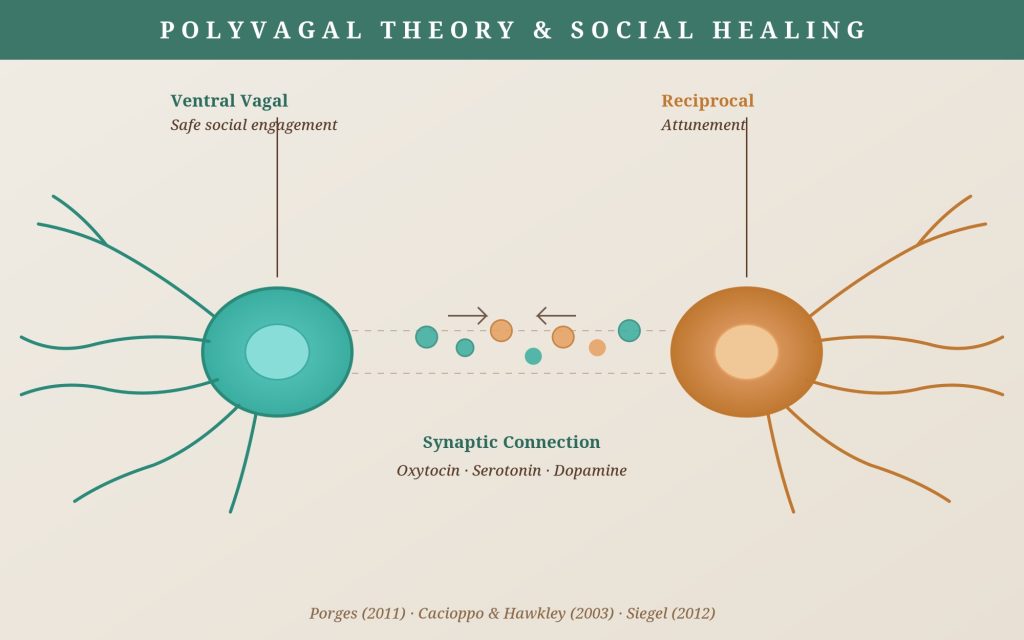
The neurobiological case for human connection in recovery is stronger than it has ever been. Isolation is not a neutral condition — it is an active risk factor.
The claim that connection is central to recovery is not new. It is embedded in the philosophy of twelve-step programmes, in the structure of therapeutic communities, and in the intuitions of most experienced clinicians. What is relatively new — and increasingly difficult to dismiss — is the neurobiological evidence underpinning that claim.
Human beings are not simply social by preference. They are social by architecture. The brain’s threat-response systems are meaningfully regulated by the presence of trusted others in ways that no pharmacological intervention has yet been able to fully replicate.
The Neurobiology of Social Connection
Porges’ (2011) Polyvagal Theory provides a compelling framework for understanding why social connection has such a significant regulatory effect on the nervous system. The theory identifies a phylogenetically recent neural circuit — the ventral vagal complex — that supports prosocial behaviour and is activated by cues of safety in the social environment. When this circuit is active, the individual has access to a much broader range of cognitive and emotional resources than when the system is in a defensive state.
For individuals in recovery, whose nervous systems have frequently been dysregulated by prolonged substance use, chronic stress, and often significant trauma histories, the activation of this circuit through safe relational contact is not a complementary treatment strategy. It is a primary one. Connection is not the backdrop to recovery. In many cases, it is the mechanism.
“The opposite of addiction is not sobriety. It may not even be happiness. The evidence increasingly suggests it is belonging — the felt sense of mattering to other people.”
Isolation as a Clinical Risk Factor
The corollary of this understanding is that isolation is not a neutral condition in recovery. It is an active risk factor. Cacioppo and Hawkley (2003) demonstrated that perceived social isolation produces measurable changes in immune function, cardiovascular response, sleep architecture, and cognitive performance — all of which have direct implications for recovery outcomes. The isolated individual in recovery is not simply lonely. They are neurobiologically compromised in ways that make the maintenance of sobriety demonstrably more difficult.
This finding has significant implications for the design of recovery support. The frequent tendency to position individual willpower as the primary recovery resource, while treating social connection as a supplementary benefit, inverts the clinical reality. Willpower is a limited and highly variable resource. Relational connection is a renewable one.
What This Means for Recovery Practice
The practical implications are clear. Recovery environments — therapeutic, familial, and social — need to be structured around the cultivation of genuine connection, not merely the management of risk. Group work, peer support, family involvement, and community integration are not soft additions to a treatment programme. They are evidence-based components of an effective one.
For the individual in recovery who finds connection difficult — who has been hurt by relationships, who has burned bridges, who carries shame that makes vulnerability feel dangerous — the work of building relational capacity is itself a clinical priority. It is also, in the experience of most people who have done it, among the most transformative work available in the recovery process.
We do not heal in isolation. We heal in relationship — with others, and eventually with ourselves.
References
- Porges, S. W. (2011). The polyvagal theory: Neurophysiological foundations of emotions, attachment, communication, and self-regulation. W. W. Norton & Company.
- Cacioppo, J. T., & Hawkley, L. C. (2003). Social isolation and health, with an emphasis on underlying mechanisms. Perspectives in Biology and Medicine, 46(3), S39–S52.
- Siegel, D. J. (2012). The developing mind: How relationships and the brain interact to shape who we are (2nd ed.). Guilford Press.
- Kelly, J. F., Stout, R. L., Magill, M., Tonigan, J. S., & Pagano, M. E. (2011). Spirituality in recovery: A lagged mediational analysis of Alcoholics Anonymous’ principal theoretical mechanism of behavior change. Alcoholism: Clinical and Experimental Research, 35(3), 454–463.
Group facilitation and community-based recovery support is available through Healing Light SA. Connection is not a luxury in recovery — it is a clinical necessity.