Years into recovery, the substances are gone. But the internal critic remains — and without deliberate intervention, it quietly dismantles what sobriety built.
The clinical conversation around recovery tends to concentrate its attention on the acute phase — the first weeks and months during which physiological withdrawal, craving management, and behavioural stabilisation consume most of the available therapeutic space. This focus is understandable. The acute phase is dangerous, and it demands attention.
What receives considerably less attention is what happens to a person’s sense of self across years of sustained recovery — and what happens when that self-concept, unexamined and unaddressed, begins to erode the very foundation that sobriety was built on.
Self-Esteem Is Not Vanity
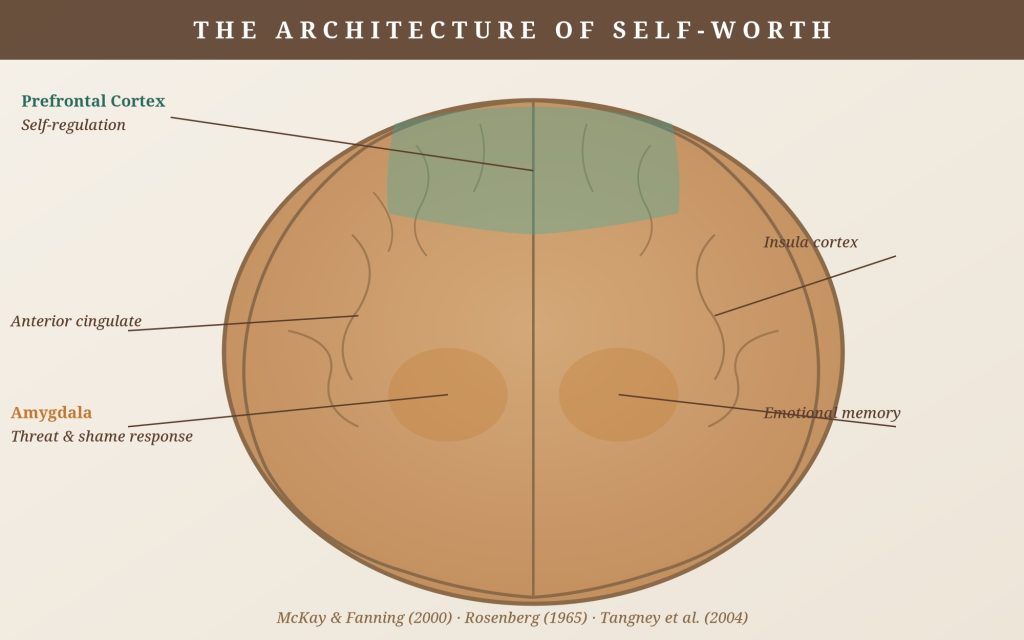
There is a persistent cultural suspicion of self-esteem work — a tendency to dismiss it as self-indulgent or tangential to the serious business of recovery. This suspicion is not supported by the evidence. Rosenberg (1965), whose self-esteem scale remains one of the most widely used instruments in psychological research, defined self-esteem as the overall evaluation a person makes of their own worth. It is not arrogance. It is the baseline level of regard a person holds for themselves — and it has been consistently linked to behavioural outcomes across a wide range of populations.
In recovery populations specifically, low self-esteem functions as a chronic stressor. It increases vulnerability to relapse, impairs help-seeking behaviour, and reduces the quality of therapeutic engagement. McKay and Fanning (2000) describe the role of the internal critic — the internalised voice of self-evaluation that, in individuals with low self-esteem, operates as a near-constant source of negative appraisal. This voice does not disappear when substances are removed. In many cases, without the numbing effect of those substances, it becomes louder.
“The substances are gone. The self-criticism that they were managing remains. And now it has nothing standing between it and the person trying to rebuild their life.”
The Relapse Connection
The relationship between self-esteem and relapse is not merely correlational. Tangney, Baumeister, and Boone (2004) demonstrated that self-regulatory capacity — the ability to manage impulses, delay gratification, and maintain goal-directed behaviour — is significantly predicted by dispositional self-worth. Individuals who regard themselves as fundamentally worthy are better equipped to tolerate the discomfort of the recovery process without seeking chemical relief from it.
This is not because high self-esteem individuals feel less pain. It is because they have a broader repertoire of responses available to them when pain arrives. They are more likely to reach out for support, more likely to engage honestly in therapeutic relationships, and more likely to persist through setbacks without interpreting those setbacks as confirmation of their fundamental inadequacy.
The Work That Needs Doing
Addressing self-esteem in sustained recovery is not a supplementary concern. It is central to the sustainability of the recovery itself. The work involves identifying the specific content and style of the internal critic, understanding its developmental origins, and building practical competencies for challenging its authority over one’s behaviour and self-perception.
This is slow work. It requires honesty, consistency, and usually professional support. But it is among the most consequential work available to a person in recovery. The substances were, for many people, a solution to an unbearable internal environment. Without addressing that environment directly, the risk of returning to those solutions remains permanently elevated.
References
- McKay, M., & Fanning, P. (2000). Self-esteem: A proven program of cognitive techniques for assessing, improving, and maintaining your self-esteem (3rd ed.). New Harbinger Publications.
- Rosenberg, M. (1965). Society and the adolescent self-image. Princeton University Press.
- Tangney, J. P., Baumeister, R. F., & Boone, A. L. (2004). High self-control predicts good adjustment, less pathology, better grades, and interpersonal success. Journal of Personality, 72(2), 271–324.
- Trucco, E. M., Colder, C. R., & Wieczorek, W. F. (2011). Vulnerability to peer influence: A moderated mediation study of early adolescent alcohol use initiation. Addictive Behaviors, 36(7), 729–736.
Self-esteem work is available through Healing Light SA as both an individual offering and as part of the Identity Reconstruction Programme.