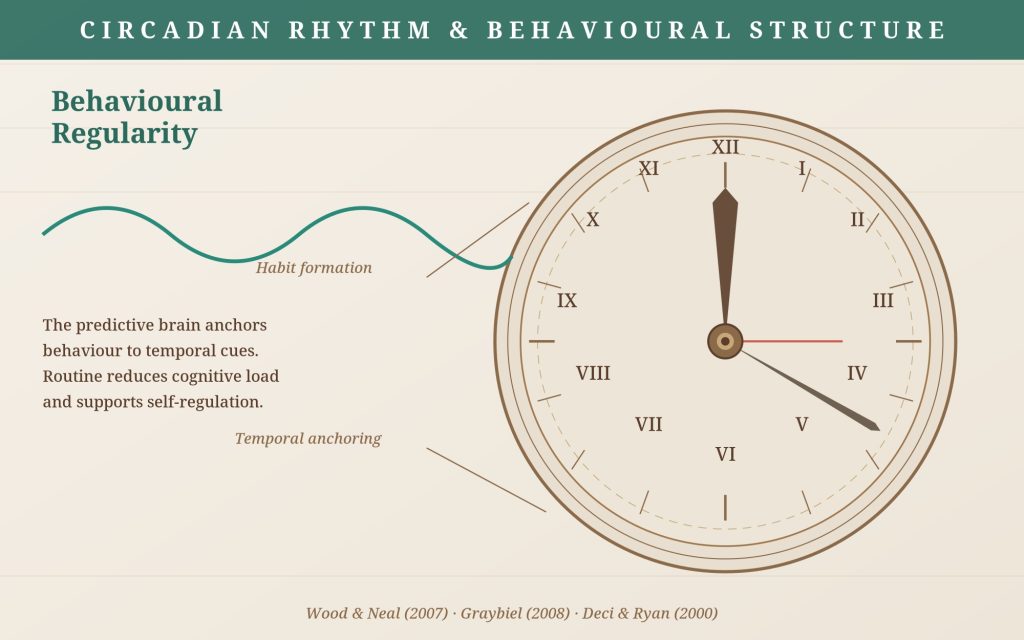
The belief that structure kills freedom has cost more recoveries than most people realise. The evidence points firmly in the opposite direction.
There is a persistent myth in recovery culture — and in wider society — that routine is the enemy of a full, creative, spontaneous life. That structure is a cage. That scheduling your day is something other people do. People who are boring, or anxious, or who simply haven’t yet learned to live freely.
This belief, left unchallenged, has derailed more recoveries than most people are willing to count. It is seductive precisely because it feels like liberation. In reality, it is one of the more reliable roads back to chaos.
What the Research Actually Shows
The relationship between routine and psychological wellbeing is well-established in the clinical literature. Wood and Neal (2007) demonstrated that habitual behaviour — repeated actions performed in stable contexts — significantly reduces the cognitive load required to manage daily life. For individuals in early recovery, whose executive functioning is frequently compromised by prolonged substance use, this reduction in cognitive demand is not a luxury. It is a clinical necessity.
Routine provides what neuroscientists refer to as predictive scaffolding — a framework through which the brain can anticipate, regulate, and respond to the environment without being overwhelmed. When that scaffolding is absent, the brain defaults to older, more entrenched response patterns. In individuals with a history of AOD use, those patterns are rarely benign.
“Structure does not restrict the self. It creates the conditions under which the self can actually show up — reliably, and on purpose.”
The Spontaneity Paradox
Here is what the resistance to routine consistently misunderstands: genuine spontaneity — the kind that enriches life rather than destabilises it — requires a stable platform from which to operate. Deci and Ryan’s (2000) Self-Determination Theory identifies autonomy as a core psychological need, but autonomy is not the same as disorder. Autonomy is the capacity to act in accordance with one’s values. Disorder is the absence of that capacity.
The person who maintains a consistent sleep schedule, eats at regular intervals, and structures their working hours is not less free than the person who does none of these things. They are, in most clinically measurable ways, considerably more free — because their behaviour is governed by intention rather than impulse.
What This Means in Practice
In working with individuals across the full spectrum of recovery — from early stabilisation to long-term maintenance — the pattern is consistent. Those who establish and protect a daily structure in the first ninety days of recovery demonstrate measurably better outcomes across relapse rates, emotional regulation, and self-reported wellbeing. Those who resist structure, citing a preference for flexibility, frequently find themselves in crisis within the same period.
This is not a moral judgement. It is a clinical observation. Structure is not punishment. It is the architecture that makes everything else possible. The creative life, the connected life, the spontaneous and richly human life — all of it is more accessible to the person who has built a reliable foundation beneath it.
The work, then, is not to choose between structure and freedom. It is to understand that one makes the other possible.
References
- Deci, E. L., & Ryan, R. M. (2000). The “what” and “why” of goal pursuits: Human needs and the self-determination of behavior. Psychological Inquiry, 11(4), 227–268.
- Wood, W., & Neal, D. T. (2007). A new look at habits and the habit-goal interface. Psychological Review, 114(4), 843–863.
- Graybiel, A. M. (2008). Habits, rituals, and the evaluative brain. Annual Review of Neuroscience, 31, 359–387.
- Volkow, N. D., Koob, G. F., & McLellan, A. T. (2016). Neurobiologic advances from the brain disease model of addiction. New England Journal of Medicine, 374(4), 363–371.
If structure is something you are actively rebuilding, individual sessions with Shane focus specifically on this — creating practical daily architecture that supports long-term recovery.