Intelligence and insight are not sufficient engines of behavioural change. If they were, recovery would be considerably simpler than it is.
Almost every person who has ever sought help for an addiction — or who has watched someone they love struggle with one — has encountered a version of the same frustrating paradox: the person knows exactly what they need to do, can articulate it clearly, understands the consequences of not doing it, and still does not do it. This gap between knowing and doing is one of the most clinically significant and most poorly understood phenomena in recovery psychology.
It is also one of the most heavily morally laden. The gap is frequently interpreted — by the person themselves, by their family, and sometimes by undertrained clinicians — as evidence of dishonesty, lack of motivation, or insufficient suffering. None of these interpretations is supported by the research.
The Prochaska Model and the Illusion of Linear Change
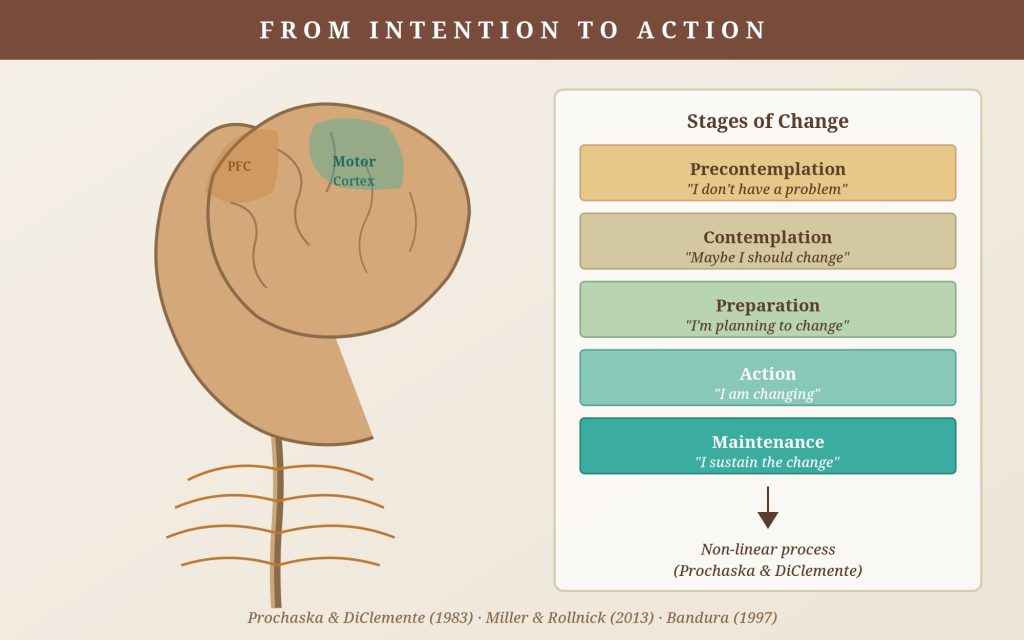
Prochaska and DiClemente’s (1983) Transtheoretical Model of behaviour change identified five stages through which individuals typically move when modifying entrenched behaviour: precontemplation, contemplation, preparation, action, and maintenance. The model’s most important contribution is not the identification of these stages, but the explicit recognition that movement through them is non-linear.
People cycle. They return to earlier stages. They act before they are ready, and they contemplate long after action has become necessary. The model de-pathologises this cyclical nature of change — treating it not as failure, but as the predictable pattern of how human beings actually alter deeply conditioned behaviour.
The knowing-doing gap is, in part, a function of stage mismatch. A person in contemplation who is being treated as though they are in preparation will not change — not because they lack the will, but because the intervention does not match their actual position in the change process.
“Knowing is cognitive. Doing is behavioural. The distance between them is not a measure of character — it is a measure of how much work remains.”
The Role of Ambivalence
Miller and Rollnick (2013), in their foundational work on Motivational Interviewing, describe ambivalence as the normal state of a person contemplating significant behavioural change. Ambivalence is not indecision or weakness. It is the simultaneous experience of genuinely wanting to change and genuinely fearing what change will require.
Attempting to resolve ambivalence through argument, confrontation, or the presentation of evidence is clinically counterproductive. Research consistently shows that direct persuasion activates psychological reactance — the tendency to resist external pressure in order to protect perceived autonomy. The more forcefully someone is pushed toward change they are ambivalent about, the more firmly they are likely to resist it.
What Actually Closes the Gap
The evidence points toward several mechanisms that reliably reduce the distance between knowing and doing. These include the development of specific implementation intentions — detailed plans that specify not just what a person will do, but when, where, and in response to what conditions. They include the cultivation of self-efficacy — the person’s belief in their own capacity to execute the required behaviour — which has been consistently identified as one of the strongest predictors of sustained behavioural change. And they include the reduction of environmental friction, which recognises that behaviour occurs in context, and that context can be deliberately structured to support rather than undermine intended action.
The knowing-doing gap is not a character deficiency. It is a distance that requires specific tools, appropriate support, and a clinical approach calibrated to where the person actually is in their change process — not where we would like them to be.
References
- Prochaska, J. O., & DiClemente, C. C. (1983). Stages and processes of self-change of smoking: Toward an integrative model of change. Journal of Consulting and Clinical Psychology, 51(3), 390–395.
- Miller, W. R., & Rollnick, S. (2013). Motivational interviewing: Helping people change (3rd ed.). Guilford Press.
- Gollwitzer, P. M. (1999). Implementation intentions: Strong effects of simple plans. American Psychologist, 54(7), 493–503.
- Bandura, A. (1997). Self-efficacy: The exercise of control. W. H. Freeman.
Working through the knowing-doing gap is exactly the kind of structured, practical work that individual sessions at Healing Light SA are designed to support.