Trust is not rebuilt through declarations of intent. It is rebuilt through behaviour, repeated over time, witnessed and acknowledged by both parties. This takes longer than anyone wants it to.
One of the most painful recurring conversations in recovery work involves trust — specifically, the gulf between the person in recovery who feels they have genuinely changed and the family members or partners who cannot yet believe it. Both positions are understandable. Both are rooted in experience. And without a clear framework for navigating the process, both sides frequently cause one another significant and unnecessary harm.
The person in recovery wants to be believed. The family members want to protect themselves from being hurt again. Neither of these needs is unreasonable. The problem is that neither can be fully met immediately, and the impatience of both parties frequently derails what would otherwise be a viable process.
Why Trust Was Lost
Addiction, by its neurobiological nature, produces behaviour that is inconsistent with the values and commitments of the person exhibiting it. Lying, manipulation, broken promises, and the subordination of relational responsibilities to the demands of continued use — these are not revelations of character. They are symptoms of a disorder. But they are experienced by those on the receiving end as personal betrayals, and that experience is valid regardless of the clinical explanation.
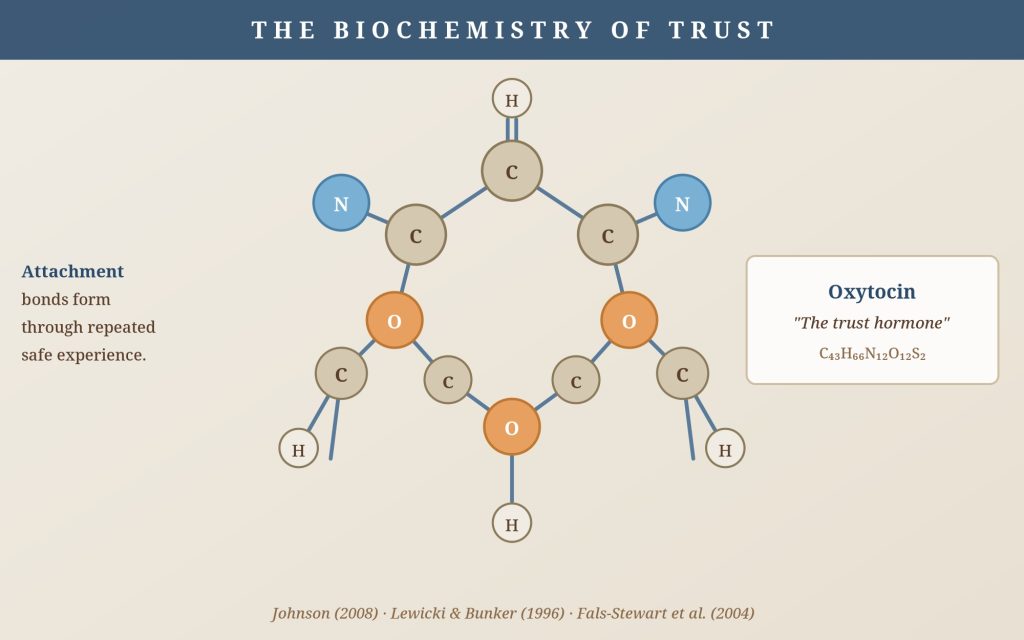
Johnson (2008), writing from an Emotionally Focused Therapy framework, describes attachment injuries as events in which a person needed their attachment figure to be present and reliable, and that figure failed them. Addiction produces attachment injuries with remarkable consistency. The person in recovery must understand that these injuries are real, that they require acknowledgement, and that they do not disappear simply because the substance use has stopped.
“Stopping the behaviour that caused the harm is necessary. It is not sufficient. Trust is not restored by the absence of harm. It is restored by the presence of something different.”
What Rebuilding Actually Requires
The research on trust repair in interpersonal relationships identifies several consistent elements. Lewicki and Bunker (1996) describe trust rebuilding as a staged process that moves from deterrence-based trust — in which behaviour is motivated by the avoidance of consequences — through knowledge-based trust, in which predictability is established through demonstrated consistency, to identification-based trust, in which shared values and genuine understanding form the foundation of the relationship.
For the person in recovery, this means accepting that the timeline for trust repair is not within their control. It is set by the accumulation of evidence, not by the sincerity of their intention. Consistent, observable behaviour over an extended period is the only mechanism through which deterrence-based trust transitions to something more durable.
For family members, the framework requires its own work. The protective stance — the emotional withdrawal, the constant vigilance, the testing — is understandable but eventually becomes its own obstacle to genuine reconnection. Therapeutic support for family members, separate from the work being done by the person in recovery, is frequently necessary for this process to proceed effectively.
The Role of Accountability
Accountability — genuine, voluntary, and specific — is among the most powerful trust-building mechanisms available to a person in recovery. Not accountability as performance, designed to manage others’ perceptions, but accountability as an expression of commitment to a different way of being in relationship. This includes transparency, consistency in following through on commitments, and the willingness to acknowledge setbacks without defensiveness.
Trust, ultimately, is rebuilt slowly, imperfectly, and together. It cannot be rushed, and it cannot be demanded. But with the right support on both sides, it is one of the more achievable goals in the recovery process.
References
- Johnson, S. M. (2008). Hold me tight: Seven conversations for a lifetime of love. Little, Brown and Company.
- Lewicki, R. J., & Bunker, B. B. (1996). Developing and maintaining trust in work relationships. In R. M. Kramer & T. R. Tyler (Eds.), Trust in organizations: Frontiers of theory and research (pp. 114–139). Sage Publications.
- Fals-Stewart, W., O’Farrell, T. J., & Birchler, G. R. (2004). Behavioral couples therapy for substance abuse: Rationale, methods, and findings. Science & Practice Perspectives, 2(2), 30–41.
- Baucom, D. H., Snyder, D. K., & Gordon, K. C. (2009). Helping couples get past the affair: A clinician’s guide. Guilford Press.
Family and couples counselling is available through Healing Light SA for both the person in recovery and those rebuilding trust alongside them.